
Digital school portals have become widespread in most French-speaking institutions. For families, these platforms consolidate grades, absences, schedules, and administrative procedures in one space. Their usefulness goes beyond simple performance tracking: they also raise concrete questions about the protection of minors’ personal data and account security, two topics rarely addressed in user guides for parents.
Child’s personal data: what school portals really collect
Most content dedicated to parent portals details the features (viewing report cards, messaging with teachers, online registration). Few focus on the nature of the data collected in the background.
The CNIL reminds parents to check what data is collected, why, and who can access it. In a digital school work environment, this includes family contact details, detailed results by subject, timestamped absences, and sometimes photographs of the child.
Prior consent from parents is required in several specific cases: collection of sensitive data, dissemination of photographs of minors, or use of information for commercial prospecting purposes. Families also have a specific right to be forgotten for minors, which allows them to request the deletion of data collected during schooling.
In practice, before validating the creation of an account on a portal, it is useful to locate the platform’s privacy policy and check the following points:
- The stated purpose of each collected data (educational tracking, administrative management, anonymized statistics, or other)
- The duration of data retention after the end of schooling at the institution
- The procedures for exercising the right of access, rectification, and deletion with the data controller
On the parent portal of Réseau Éducation Suisse, this information is centralized to facilitate the process for families, including those who enroll their children in multiple institutions.

Parent account security: an underestimated weak link
A school portal provides access to sensitive data about the entire family. The compromise of a single parent account can expose identity, address, academic history, and communications with teachers.
The CNIL’s recommendations on this point are explicit: use strong and distinct passwords for each service, limit administrator rights on devices used by the child, and control privacy settings. However, these practices are rarely integrated into the functional presentations of the portals.
Password and authentication
Account creation generally involves a temporary code sent via SMS. This initial code must be immediately replaced by a personal password. Several portals also offer login via FranceConnect, adding an extra layer of authentication.
A simple but rarely applied reflex: never reuse the same password as that of personal email. If the school portal is compromised, the email will remain secure, and vice versa.
Shared family devices
When the same computer or tablet is used by the whole family, the school portal session must be closed after each consultation. Leaving a session open on a device accessible to the child or their siblings poses a concrete problem: the child may view communications between parents and teachers that were not intended for them.
Supporting schooling without monitoring: finding the limit
Parent portals offer real-time access to grades, teacher comments, and absences. This transparency facilitates tracking, but it can also alter the relationship between parent and child if every evaluation is discussed on the same evening.
The CNIL recommends setting privacy parameters with the child and discussing their online usage. The stated goal is a gradual digital autonomy, not permanent control. In practice, feedback on this point varies: some parents believe that daily grade checking enhances dialogue, while others find it generates counterproductive pressure.
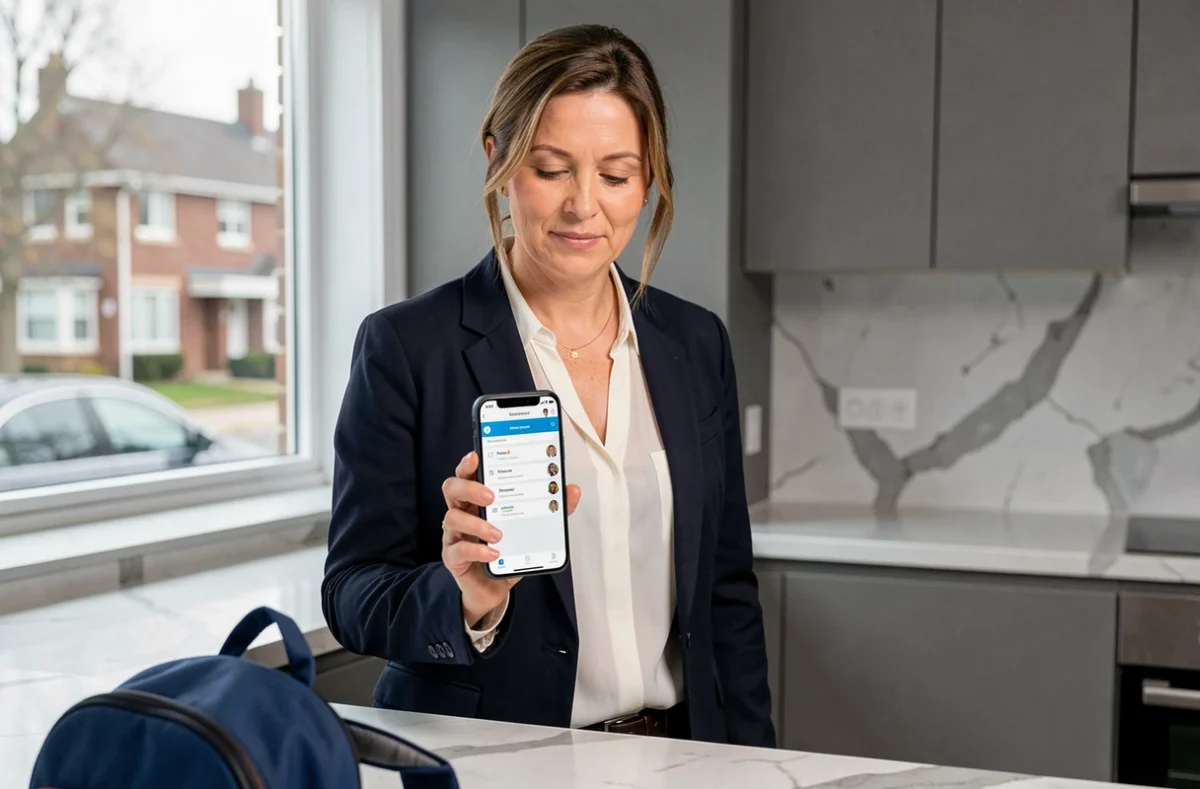
Adapting the level of monitoring to age
In kindergarten and primary school, the portal mainly serves for registration procedures and communication with the teaching team. Performance tracking is less granular than in middle or high school.
From middle school onwards, report cards become detailed and frequent. It is at this stage that the issue of orientation begins to appear in the portals, with resources dedicated to families. Consulting these resources with the child rather than on their behalf encourages their involvement in orientation choices.
School portal and administrative procedures: what has changed
The dematerialization of procedures related to schooling (registration, option choices, scholarships, information sheets) has progressed in recent years. For families, this means fewer paper documents to submit, but also increased responsibility for updating information online.
A change of address, phone number, or family situation must be reported directly on the portal so that the institution and the town hall have up-to-date information. Incorrect data can delay sensitive procedures such as assignment to a new institution.
- Online registration is gradually replacing paper files in most academies
- Scholarship applications and canteen forms now go through the same unique access
- Updating contact details is the sole responsibility of the legal guardian connected to the portal
The school portal is therefore not limited to a tool for checking results. It serves as the administrative entry point for the family into the institution, from the first day of kindergarten to the end of high school. Regularly checking the accuracy of the information contained therein remains the simplest, and probably the most neglected, precaution.