Choosing a gas hose involves more than measuring the distance between a cylinder and an appliance. The type of hose, its material, its manufacturing date and the actual route of the connection all determine whether the installation is compliant and safe. This article compares the technical factors that influence the choice of gas hose length and explains the key points that are often overlooked during installation.
Comparing gas hoses: material, length and service life
Two main types of gas hose are available on the French market. Their characteristics directly affect the usable length and how often they need to be replaced.
| Criterion | Rubber hose (flexible tube) | Stainless steel hose (metal hose) |
|---|---|---|
| Material | Synthetic rubber | Corrugated stainless steel |
| Typical length | Up to 1.5 m | Up to 2 m, depending on the model |
| Connection | Hose clamp | Screw-on fitting |
| Expiry date | Yes (printed on the hose) | Unlimited service life if compliant |
| Compatible gases | Butane and/or propane (check the markings) | Butane, propane, natural gas |
Rubber hose is still the most widely used option for butane or propane cylinders in kitchens. Its expiry date, printed on the tube, means it must be replaced periodically. An expired hose can pass a leak test and still be dangerous: as rubber ages, its wall weakens without necessarily causing an immediate leak.
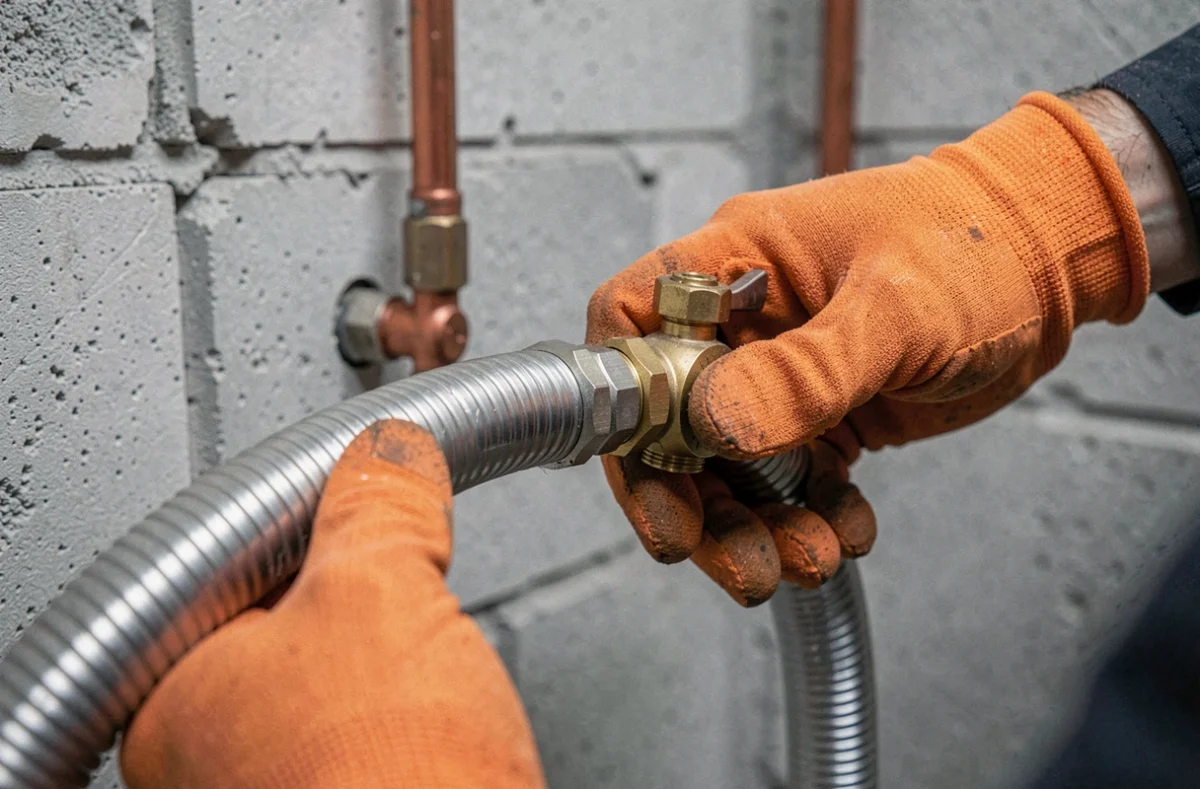
Stainless steel hose, secured with a screw-on fitting, offers greater mechanical strength. It is also suitable for natural gas installations. It costs more to buy, but its lack of an expiry date makes it more economical over time.
To learn more about sizing gas pipework, several factors need to be considered together beyond simply choosing the material.
Gas hose length: the actual route matters more than the theoretical distance
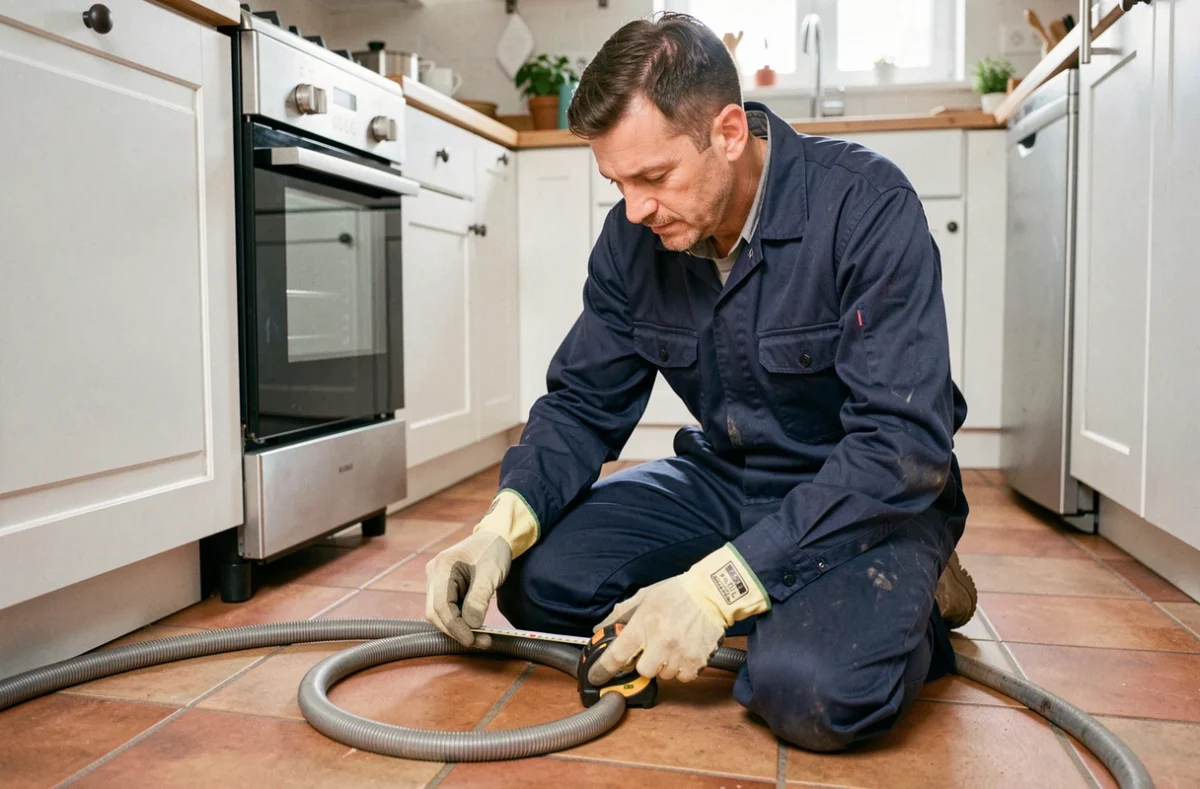
Measuring the straight-line distance between the cylinder and the appliance is not enough. The hose follows an actual route around furniture, along a wall or down behind a worktop. Every bend or detour adds to the required hose length.
A hose that is too short puts strain on the connection. Sudden movements, such as moving a plancha trolley or opening a drawer, can put stress on the connection to the regulator. Conversely, a hose that is too long can form loops that may get trapped, kink or come into contact with a heat source.
How to measure before buying
- Map the exact route from the cylinder regulator to the appliance connection, following walls and going around obstacles.
- Add a few centimetres of slack to allow for movement without stretching the hose.
- Make sure the hose will not pass close to a burner, oven or flue.
- Never join two hoses end to end to make up for insufficient length: this is considered a fault during a gas safety inspection.
A hose around 1 m long is suitable for most standard kitchens, where the cylinder is stored in the cabinet beneath the hob. For outdoor setups, such as a barbecue or plancha on a trolley, measure again whenever the layout changes.
Kitchen renovation and gas hoses: the risk of reusing an existing connection
When a kitchen is remodelled, the hob or cooker is often moved by a few dozen centimetres, sometimes more. The existing hose, even if it is in good condition, may then be too short, too long or forced around a tight corner.
A common instinct is to keep the hose already in place. This creates two problems. The first is geometric: the new route introduces bends that the hose did not have to accommodate before. The second is regulatory: a rubber hose nearing its expiry date should not be reinstalled in a different configuration.
What to check after a kitchen renovation
A gas safety inspection, required when selling or renting a property with an installation more than fifteen years old, includes checking appliance connections. A hose that is unsuitable for the new route may be flagged as a fault, even if it is not leaking.
Replacing the hose whenever the kitchen is remodelled eliminates this risk. A new hose costs relatively little compared with the cost of bringing the installation up to standard later or arranging a follow-up inspection.
Standards and safety: regulatory requirements for gas pipework
The amended decree of 2 August 1977 and standard NF DTU 61.1 govern all gas installations in France. Only copper (NF EN 1057), steel and pliable corrugated stainless steel tubing (PLT) are permitted for fixed indoor pipework. PEX and PVC are strictly prohibited for transporting gas.
For appliance connection hoses, regulations distinguish between indoor and outdoor use. A metal hose supplying an appliance located outdoors from a cylinder also placed outside is subject to specific rules that allow for greater lengths.
Only a certified PG (Professionnel du Gaz) professional may work on a fixed installation. A homeowner can replace a connection hose on a cylinder, provided they follow the manufacturer’s markings and check the connection for leaks after installation.
Two separate checks that should not be confused
The absence of a leak does not guarantee that the hose is compliant. A test with leak-detection solution confirms that the connection is airtight, but says nothing about the condition of the rubber inside or whether the expiry date has passed. Leak-tightness and compliance must be checked separately.
Choosing the right gas hose means considering three factors together: a material compatible with the type of gas used, a length suited to the actual route, and compliance with expiry dates for rubber models. When renovating a kitchen, replacing the hose as a matter of course is the most reliable way to keep the installation compliant.